
Best quit smoking apps in 2026, and how to actually tell them apart
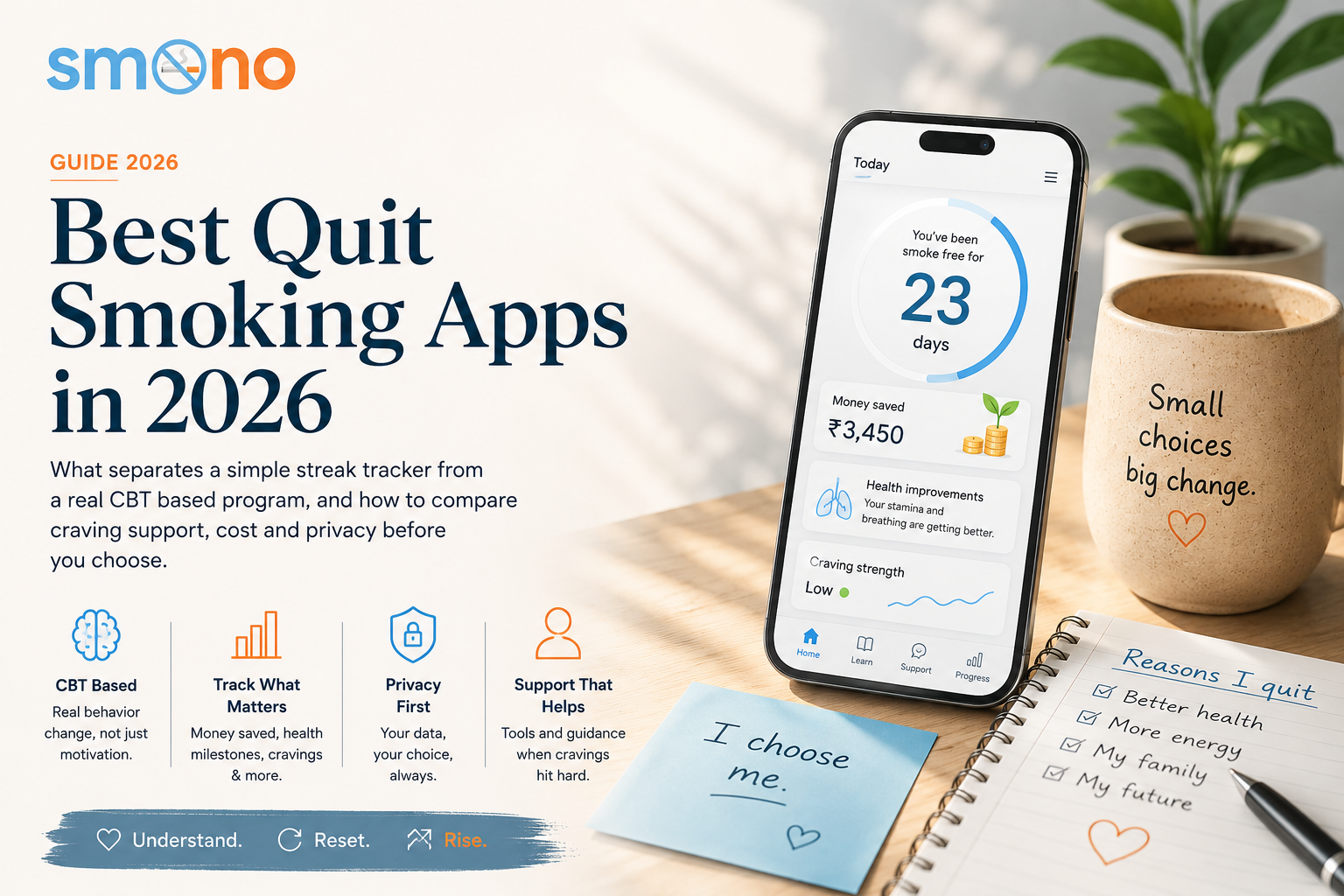
There are dozens of quit smoking apps, and most comparison lists online are written by the apps themselves. Here is an honest way to evaluate any of them, the real differences between a streak tracker and a CBT based program, and where Smono fits into the picture.
Most quit smoking apps fall into one of these three categories. Knowing which one you are looking at makes comparing them far easier.
Searching for the best quit smoking app usually turns up a long list of nearly identical sounding results, and a fair number of the articles ranking them turn out to be written by the apps themselves. That does not make any of them useless, but it does mean the ranking is rarely neutral. A more useful question than which app is best is which type of app actually addresses why you smoke, and what specifically to compare once you know that.
The three types of quit smoking apps
Streak trackers are the simplest and most common. They count the days since your last cigarette, estimate money saved, and show milestones like badges or achievements. They work well as a visible record of progress, but most offer little beyond information the moment an actual craving hits.
Gamified and community apps add levels, missions, or a peer support network on top of tracking. These can be genuinely motivating early on, since seeing other people at the same stage helps some people feel less alone in the process. The common limitation is that motivation built on gamification tends to fade well before the underlying habit does.
CBT based programs take a different approach entirely. Rather than mainly tracking the outcome, they work on the thought patterns and triggers that drive the craving in the first place, session by session. This usually asks for more day to day engagement than a simple tracker, but it targets a different, deeper part of the problem.
None of these categories is automatically wrong for everyone. The right fit depends on whether what is keeping you smoking is mostly a matter of building a new routine, staying motivated with company, or working through specific beliefs and triggers that keep pulling you back.
What actually predicts whether an app helps
Putting categories aside, a handful of specific features consistently separate a genuinely useful quit smoking app from one that looks impressive but offers little when it matters.
An evidence based method, not just motivation
Look for an app built around an established approach, most commonly Cognitive Behavioral Therapy, rather than one relying purely on reminders and encouragement. CBT specifically targets the thought behind a craving, which tends to reduce the craving itself over time rather than only asking you to resist it. We have written in more depth about why willpower alone tends to fail if you want the fuller explanation.
Something to actually do during a craving
A craving typically peaks and fades within a few minutes, whether or not you smoke. The apps that help most in that window give you a specific, immediate action, a breathing exercise, a short prompt, a grounding technique, rather than only information about what a craving is. If an app's craving support amounts to a paragraph of text, that is worth noticing.
Personalization that goes beyond your name
Many apps ask a few onboarding questions and then deliver the same content to everyone regardless of the answers. A more useful app adapts what it shows you based on your actual triggers, whether that is stress, boredom, social situations, or habit, from the very first day rather than treating personalization as a decoration.
A real cost of smoking, not a generic estimate
Money saved is one of the most motivating numbers a quit app can show, but only if it reflects your actual local cigarette prices rather than a rough global average. We broke down exactly why this matters in the real cost of smoking, and it is worth checking whether an app's savings tracker uses your real numbers or a generic guess.
Clear pricing and clear data practices
A trustworthy app states its price plainly, without vague language like limited time offers dressed up as urgency. It should also be clear about what personal data it collects and why, particularly since a quit smoking app often knows sensitive details about your habits, triggers, and emotional patterns.
A simple checklist before you choose
Where Smono fits
Smono is a structured, thirty day program built specifically around Cognitive Behavioral Therapy, so it sits firmly in the third category above rather than functioning mainly as a tracker. In plain terms, here is what that means in practice.
What Smono actually does
- Identifies your specific triggers and beliefs from day one and personalizes daily sessions accordingly, rather than delivering the same content to everyone
- Tracks how five core beliefs about smoking change across the program, at the start, the midpoint, and the end, so progress is visible beyond a day count
- Captures the actual thought behind a craving when you log one, not only the trigger, which is the detail most tracking apps skip entirely
- Uses real, local cigarette pricing across thirty countries, so the money saved figure reflects your actual spending rather than a rough average
- Offers a free first step before any payment, with clear, upfront pricing shown in your local currency afterward
Smono will not be the right fit for everyone. If what you mainly want is a simple streak counter and nothing more, a lighter tracking app may suit you better. If you want a program that works on the beliefs and habits underneath the craving rather than only measuring the outcome, that is specifically what Smono is built for.
Whichever direction you go, the checklist above holds regardless of which app you end up choosing. An honest comparison is less about finding a single best answer and more about knowing exactly what you are looking at before you commit to it.
Common questions
What is the best quit smoking app?
The best quit smoking app for you depends on what actually drives your smoking. A simple streak tracker works well for some people, but apps built on Cognitive Behavioral Therapy tend to help more with the underlying beliefs and triggers that make quitting difficult, rather than only measuring how many days have passed.
Is there a free quit smoking app?
Yes, several quit smoking apps offer a free tier with basic tracking, and many structured programs, including Smono, offer a free first step before any payment is required. Free versions typically include streak tracking and simple reminders, while structured, personalized CBT programs are more commonly offered as paid plans.
Do quit smoking apps actually work?
Apps built around evidence based methods, particularly Cognitive Behavioral Therapy, are generally considered more effective than apps that only track streaks, because they address the thought patterns behind cravings rather than asking users to rely on willpower alone. Effectiveness still depends heavily on how consistently the app is used.
What should a quit smoking tracker actually show?
A useful tracker goes beyond a simple day count. It should show real money saved using your local cigarette prices rather than a generic estimate, physical health milestones as your body recovers, and craving patterns over time, so you can see genuine progress rather than only a number climbing.
What is the best app for nicotine addiction specifically?
For nicotine addiction specifically, apps that combine craving support tools with a structured behavioral program tend to perform better than motivation only apps, since nicotine cravings are strongly tied to learned triggers as well as physical dependence. Look for an app that addresses both.
See if a CBT based program fits you
Smono personalizes your thirty day program from day one, and tracks real progress beyond a simple streak.
Begin your resetFrom $24/month, priced in your local currency · Start free