
Can AI chat support help prevent smoking relapse?
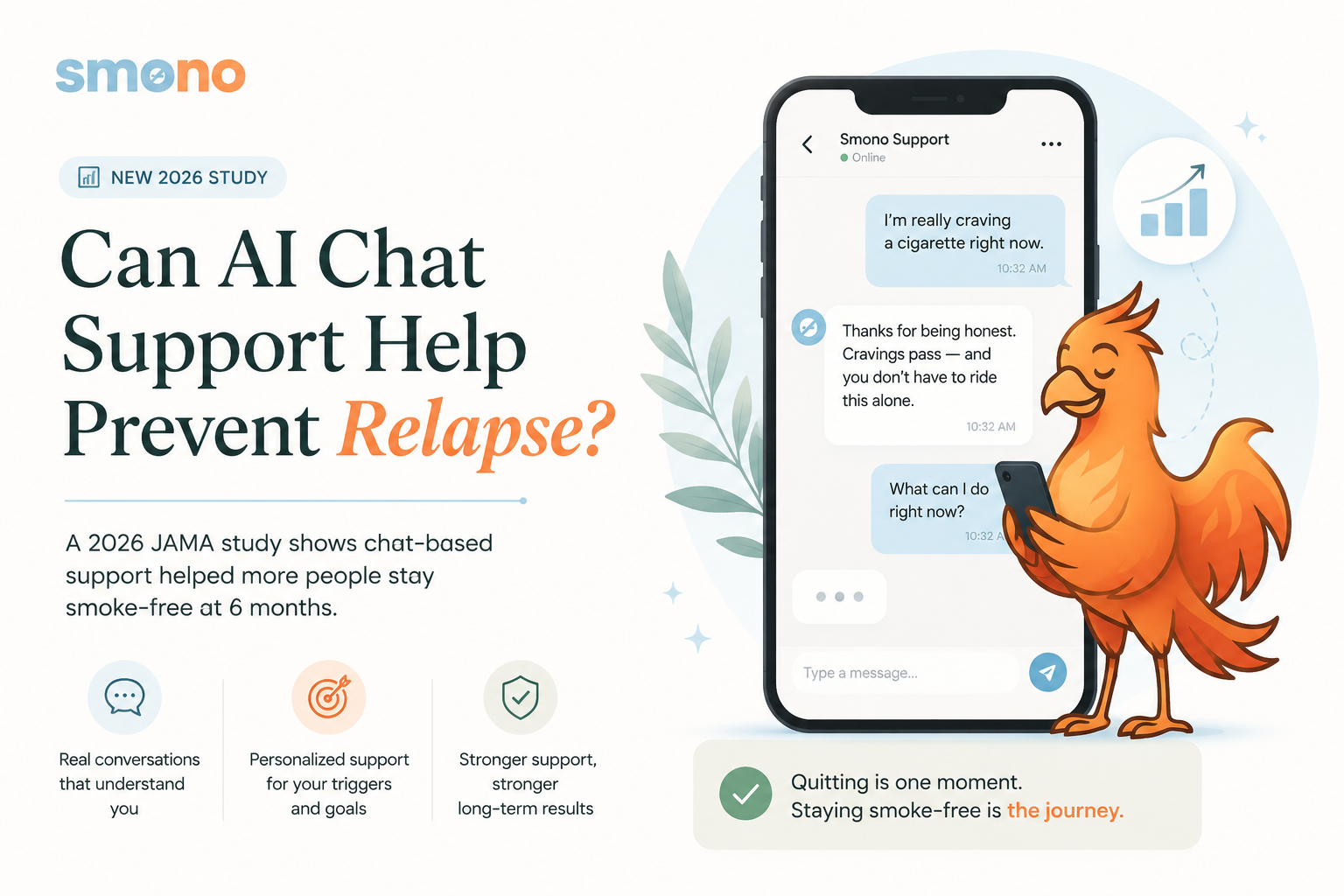
A randomized clinical trial published in JAMA Internal Medicine in 2026 tested whether mobile chat support could help people who had already quit smoking stay quit. Here is exactly what it found, what it does not prove, and where personalized digital support may genuinely fit in.
From Luk et al., 2026, JAMA Internal Medicine, a randomized clinical trial of 590 adults in Hong Kong.
Why relapse support matters after the quit date
Most attention in quitting smoking goes to the quit date itself, the last cigarette, the first smoke free day. But most relapse does not happen on day one. It happens weeks or months later, often during a stressful moment, a social situation, or a stretch where motivation has quietly faded and the original support has stopped. A large share of people who successfully quit for a short period return to smoking within the following months, even when they used effective treatment to get there in the first place.
This is exactly the gap a new study set out to test, not whether people can quit, but whether ongoing support after quitting can help them stay quit.
What the 2026 randomized trial examined
Researchers led by Tzu Tsun Luk and colleagues at the University of Hong Kong ran a randomized clinical trial published in JAMA Internal Medicine in 2026, testing a mobile chat based relapse prevention intervention against a contact control.
Participants had already made a quit attempt, meaning this trial was specifically about staying smoke free, not about quitting for the first time. That distinction matters, since relapse prevention and initial quitting are genuinely different challenges.
Chat messaging versus standard automated texts
The two groups received meaningfully different support over the following three months.
The intervention group received a relapse prevention program combining chat based support from a live counselor with access to a supportive chatbot, both delivered through a messaging app, allowing back and forth conversation rather than one way messages.
The control group received eight text messages containing generic smoking cessation advice over the same three month period, a fixed schedule with no ability to respond or ask a question.
In plain terms, one group could have something closer to an actual conversation about what they were going through. The other group received information, on a schedule, regardless of what was actually happening in their week.
What the results showed
At six months, 45.9 percent of the chat support group had biochemically validated abstinence, confirmed through exhaled carbon monoxide or a salivary cotinine test rather than self report, compared with 35.5 percent of the control group. That difference was statistically significant.
The pattern held across every secondary measure the researchers tracked. Prolonged abstinence was higher in the chat support group, 57.5 percent versus 47.6 percent. Seven day point prevalence abstinence was higher, 65.6 percent versus 54.7 percent. And relapse itself, defined as seven consecutive days of smoking, was meaningfully lower, 33.0 percent versus 44.9 percent.
Why conversations may feel more useful than generic reminders
A fixed text message cannot respond to what is actually happening in someone's day. It cannot ask what triggered a craving, acknowledge a hard week, or adjust its tone when someone is clearly struggling versus doing fine. A conversational format, whether with a person or a well designed automated system, can at least attempt to.
This lines up with a broader pattern that shows up across quitting research generally, that support tailored to the actual moment tends to outperform support delivered on a generic schedule regardless of what is happening for the person receiving it. It is also consistent with something we have written about before, that a craving or a difficult moment is specific and situational, not a vague, constant state, so support that can respond to the specific situation has a real advantage over support that cannot.
Where AI personalized support could help
This is the part worth being precise about. The trial's intervention combined a live human counselor with a chatbot, not a chatbot on its own. What the results support is that responsive, two way, personalized support outperforms generic scheduled texting for relapse prevention. That is genuinely encouraging for the broader category of tools built around personalization and responsiveness, including AI native approaches, since it suggests the format itself, not necessarily a human on the other end specifically, may be a meaningful part of what worked.
Smono is built around exactly this principle, personalizing content and craving support to a person's specific triggers and patterns rather than sending the same message to everyone, and using structured Cognitive Behavioral Therapy to address the belief behind a craving directly. This study adds real, credible evidence for the general direction that approach is built on. It is a supporting data point, not a claim that Smono itself has been through a trial like this one.
What the study does not prove
A few things are worth being explicit about, since overstating a single study is exactly how good research gets misused.
- The intervention bundled a live counselor together with a chatbot. The trial cannot separate how much of the benefit came from each part, so it does not prove that a chatbot alone, without a human counselor involved, produces the same result.
- Participants had already completed a quit attempt and were engaged with clinic based cessation services in Hong Kong. Results in a different population, or among people who have not yet sought any treatment, may look different.
- Chat support was tested as an addition to existing, evidence based cessation treatment, not as a standalone replacement for it.
- This trial did not evaluate Smono, or any other specific commercial app. It supports the general principle behind personalized, responsive digital support, not a specific product's effectiveness.
How to build a relapse prevention plan
Whether or not any specific app is part of it, the ingredients of a solid relapse prevention plan are fairly consistent across the research.
If a slip has already happened, we wrote a full, practical guide on what to do after smoking one cigarette after quitting, which covers exactly this moment in more depth. And if you want to understand why generic willpower based approaches struggle in the first place, why willpower fails when you quit smoking goes into the psychology behind it.
When to seek professional or medical support
This article summarizes published research for general information and is not medical advice. If you are pregnant or breastfeeding, have an existing health condition, take regular medication, or find that mood, anxiety, or cravings feel unmanageable on your own, please speak with a doctor or another qualified healthcare professional, who can offer support suited to your specific situation.
Common questions
What is an AI smoking cessation app?
An AI smoking cessation app uses personalization, automated conversation, or both to support someone quitting smoking, adapting content or responses to a person's specific triggers and patterns rather than sending the same message to everyone. This is different from a simple streak tracker or a fixed schedule of reminder texts.
What did the 2026 JAMA study find about chat support and smoking relapse?
A randomized clinical trial of 590 adults who had recently quit smoking, published in JAMA Internal Medicine in 2026, found that adding 3 months of mobile chat based support to standard care produced significantly higher 6 month, biochemically validated abstinence than a contact control receiving 8 generic text messages, 45.9 percent versus 35.5 percent.
Is a smoking cessation chatbot as effective as talking to a real counselor?
The 2026 trial cannot answer this directly, because the intervention group received both a live counselor and access to a chatbot together, not a chatbot in isolation. The trial shows that combined, responsive chat support outperformed generic texts, but it does not separate how much of that benefit came from the human counselor versus the chatbot.
How can I prevent smoking relapse after quitting?
Useful approaches include ongoing support rather than a program that ends the day you quit, a specific plan for known high risk situations, tracking your own triggers so patterns become visible, and treating any slip as information to learn from rather than a reason to give up on the attempt entirely.
Does personalized digital support work better than generic reminder texts for quitting smoking?
The 2026 JAMA trial found that responsive chat based support produced meaningfully better 6 month abstinence than a fixed set of generic text messages. This is consistent with a broader pattern in digital health research, that interactive, tailored support tends to outperform one way, generic messaging, though results vary across studies and populations.
Personalized support, built for the moment you are in
Smono adapts to your specific triggers from day one, with a structured CBT program built for staying smoke free, not just quitting once.
Begin your resetFrom $24/month, priced in your local currency · Start free