
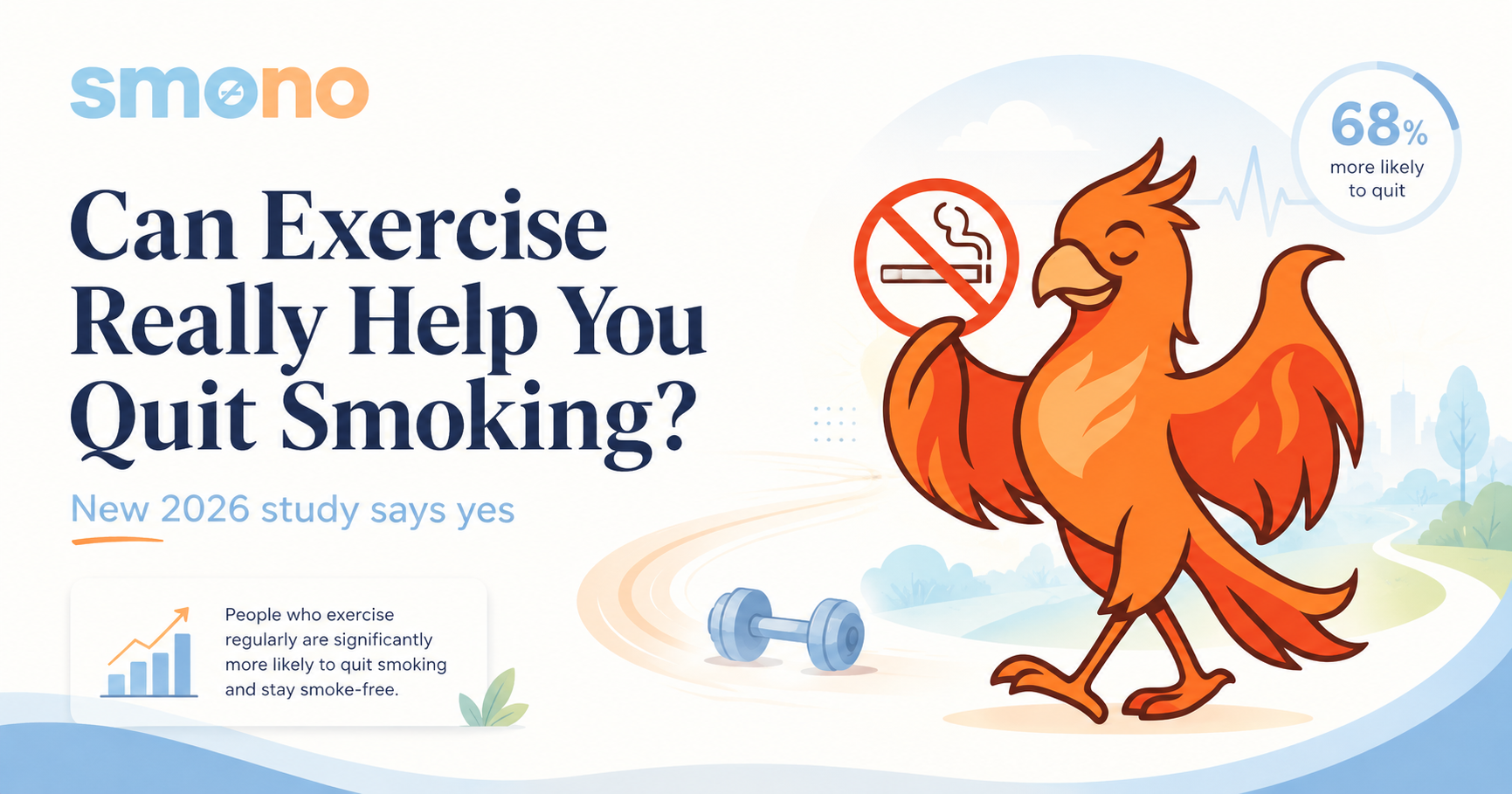
Can exercise really help you quit smoking? A new study says yes
A major review of 59 trials and more than 9,000 participants found that a single workout can cut nicotine cravings for up to half an hour. Here is exactly what the researchers found, and how to actually use it the next time a craving hits.
From Singh et al., 2026, Journal of Sport and Health Science, a systematic review and meta analysis of 59 randomized controlled trials.
A new piece of research has been making the rounds in health news over the past few weeks, and it is worth paying attention to if you are trying to quit smoking or thinking about starting. Researchers from the Alliance for Research in Exercise, Nutrition and Activity at Adelaide University, led by Ben Singh and Carol Maher, pulled together fifty nine randomized controlled trials covering more than nine thousand participants, one of the most comprehensive reviews of exercise and smoking cessation to date, and published their findings in the Journal of Sport and Health Science in 2026.
The short version is genuinely encouraging. Exercise will not quit smoking for you, but the evidence now behind it as a supporting tool is stronger than most people realize.
What the study actually found
Compared with people who did not take part in an exercise program, those who did were fifteen percent more likely to achieve continuous abstinence and twenty one percent more likely to report not smoking over a seven day period. On average, participants in exercise programs also smoked about two fewer cigarettes per day than those in control groups.
The most immediately useful finding, though, is what happened after a single workout rather than a long term program. A single bout of exercise produced a clear reduction in nicotine cravings right afterward, and that effect was still measurable ten, twenty, and thirty minutes later. Higher intensity exercise produced the largest short term drop in cravings specifically, while aerobic exercise showed the clearest benefit for staying smoke free over the longer training programs.
As lead researcher Ben Singh put it in comments accompanying the study, quitting smoking is one of the hardest things a person can do, and current approaches simply do not work for everyone, which is exactly why a low cost, widely accessible tool like exercise matters.
Why this fits what we already know about cravings
This finding lines up closely with something we have written about before on this blog. A nicotine craving typically rises and falls within a few minutes on its own, whether or not you smoke, a pattern we broke down in more detail in our guide to the nicotine withdrawal timeline. What this new research adds is a genuinely useful tool for that exact window. If a craving already tends to fade within a few minutes, a short burst of movement appears to extend that relief well beyond the craving's natural lifespan, covering almost the entire stretch where relapse risk is highest.
What kind of exercise, and when
The research points to two slightly different uses, depending on what you are solving for.
For an acute craving right now, higher intensity movement produced the strongest immediate effect in the studies reviewed. That does not have to mean a full workout. A brisk fast walk, a flight of stairs taken quickly, a few minutes of jumping jacks or bodyweight movement, anything that raises your heart rate for a short burst, appears to be enough to blunt a craving meaningfully.
For staying smoke free over the following weeks, aerobic exercise, walking, cycling, swimming, anything sustained, showed the clearest benefit in the longer term training studies. This points toward building some regular movement into your routine generally, not only reaching for it during a craving.
A simple routine for the moment a craving hits
That last step matters more than it might seem. Exercise appears to be genuinely effective at handling the acute spike of a craving, but the belief underneath it, I need this to relax, I need this to focus, is what brings the craving back in the same situation next week. This is exactly the gap Cognitive Behavioral Therapy is built to close, working through the thought itself rather than only managing the moment it produces. We go into that in more depth in why willpower fails when you quit smoking, and it is a useful companion to this particular finding, since the two approaches are solving different parts of the same problem.
A quick note on safety
This is general information, not medical advice. If you have a heart condition, are pregnant, or have any concern about starting new physical activity, speak with a doctor before increasing exercise intensity. Exercise is described here as a complementary tool, not a replacement for counseling, nicotine replacement therapy, or a structured quit program.
None of this replaces the deeper work of understanding why you smoke in the first place, which is what a structured program is for. But as a specific, evidence backed answer to the question of what to actually do in the exact moment a craving hits, this is about as concrete and well supported as it gets, and it costs nothing to try the next time you feel the urge.
Common questions
Does exercise actually help you quit smoking?
According to a 2026 systematic review and meta analysis of 59 randomized controlled trials involving more than 9,000 participants, published in the Journal of Sport and Health Science, people taking part in exercise programs were 15 percent more likely to achieve continuous abstinence and 21 percent more likely to report not smoking over a 7 day period, compared with control groups.
How long does exercise reduce nicotine cravings for?
The same 2026 review found that a single bout of exercise produced a noticeable reduction in nicotine cravings immediately afterward, with the effect still measurable 10, 20, and 30 minutes later. Higher intensity exercise produced the largest short term drop in cravings.
What type of exercise is best for smoking cravings?
The research suggests the two goals call for slightly different approaches. Higher intensity exercise produced the strongest immediate reduction in cravings during a single session, while aerobic exercise showed the clearest benefit for continuous abstinence across longer term training programs.
Can exercise replace nicotine replacement therapy or a quit program?
No. Researchers behind the 2026 review describe exercise as an additional tool alongside existing approaches such as counseling, nicotine replacement therapy, and structured programs, not a replacement for them. It appears most useful as something to reach for during a specific craving, alongside a broader plan.
Why does a short workout reduce a cigarette craving?
The exact mechanism is still being studied, but researchers note that exercise affects mood, stress hormones, and the brain's reward pathways in ways that can temporarily ease the discomfort driving a craving. It also occupies attention and the body during the short window when a craving is at its strongest.
Handle the moment, then work on the belief behind it
Smono pairs practical, in the moment tools with a thirty day CBT program that works on the thoughts driving your cravings in the first place.
Begin your resetFrom $24/month, priced in your local currency · Start free