How to stop smoking: NHS app, NRT and a practical quit plan
Between the NHS Quit Smoking app, your Personal Quit Plan, local stop smoking services and nicotine replacement therapy, there is genuinely good free support available. Here is how the pieces fit together, and where a structured CBT programme like Smono adds something none of them cover on their own.
A written plan, however simple, consistently helps people stick to a quit attempt better than relying on memory and willpower alone.
Deciding to stop smoking is the easy part. The next few weeks are where most attempts either take hold or quietly fall apart, and the difference usually comes down to whether there was an actual plan behind the decision. The good news for anyone quitting in the UK is that proper, free support already exists, through the NHS Quit Smoking app, local stop smoking services, and nicotine replacement therapy. The part worth adding to it is a structure for the habits and thoughts that keep pulling you back, which is where a CBT based approach fits in.
Choose a quit date
A vague intention to stop soon rarely turns into action. A specific date does. Pick a day within the next two to four weeks, close enough to feel real and soon enough that motivation does not fade, but far enough away to prepare properly.
A few things tend to help when choosing the date. Avoid a particularly stressful week if you can, since the first few days are already demanding without extra pressure on top. Tell people close to you, since saying it out loud to someone else makes it far harder to quietly let the date slip. And treat the date itself as fixed once chosen, rather than something to be moved at the first sign of doubt.
Build your Personal Quit Plan
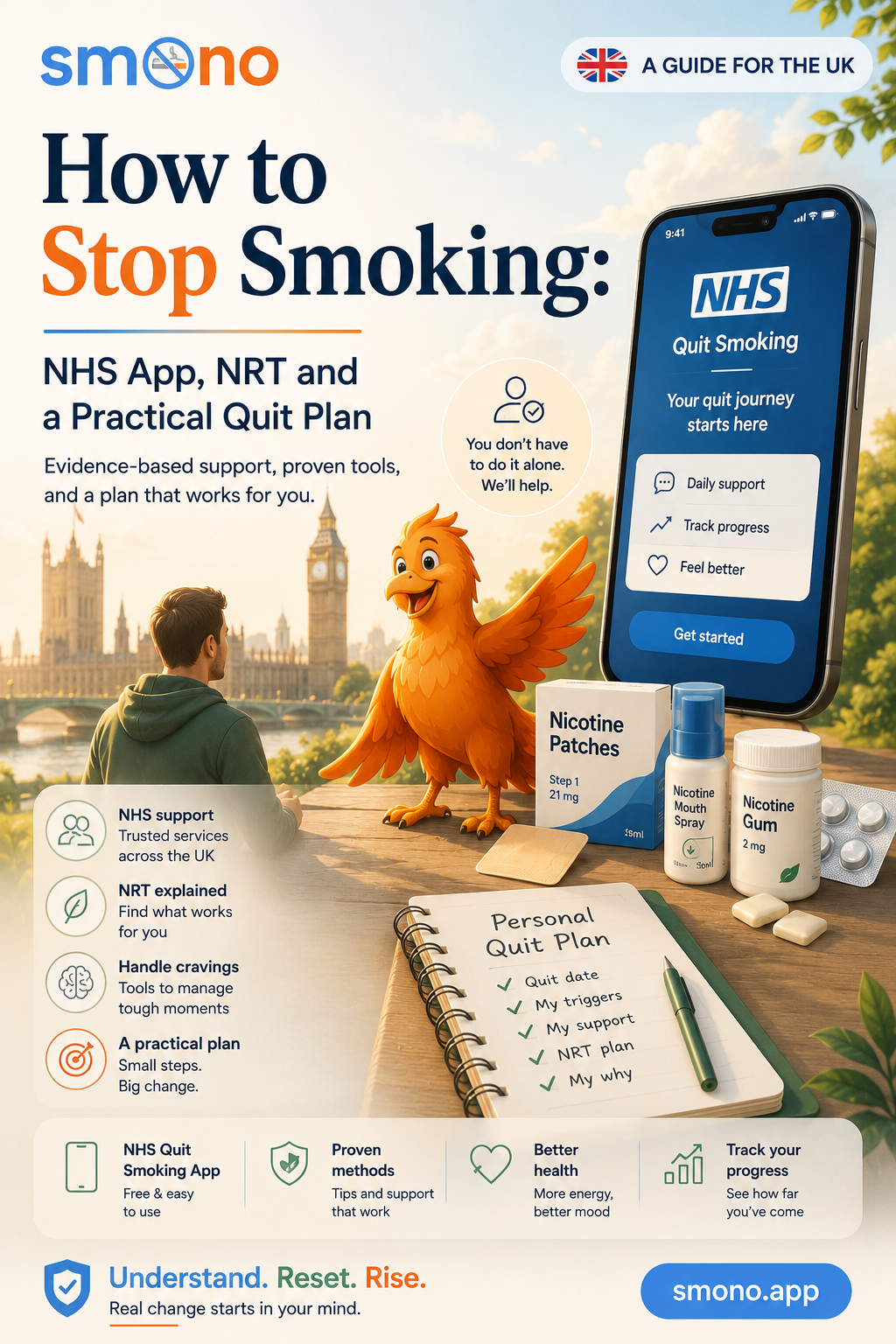
A Personal Quit Plan simply means writing down, in advance, how you intend to handle the weeks ahead rather than figuring it out in the moment. The NHS Better Health quit smoking service can help build one, and it typically covers your quit date, the type of support you want, your usual triggers, and a plan for what to do when a craving arrives.
The value of writing this down is not the document itself. It is that decisions made calmly in advance are far more reliable than decisions made in the middle of a craving, when the part of your brain doing the deciding is not exactly at its best.
NHS Quit Smoking app and local services
The NHS Quit Smoking app, available through NHS Better Health, gives daily support, progress tracking, and practical tips through the early weeks, and it costs nothing to use.
Local stop smoking services go a step further, offering one to one support from a trained adviser, either in person or by phone, and in many areas this comes with free or discounted NRT as part of the programme. People who combine professional support like this with an additional structured plan generally find the first few weeks noticeably more manageable than going it alone.
None of this is in competition with an app like Smono. If anything, the two work well together, since NHS services and NRT address the practical and physical side of quitting, while a CBT based programme works on the thoughts and habits sitting underneath the craving itself.
NRT options explained
Nicotine replacement therapy works by giving the body a controlled, much lower dose of nicotine without the thousands of other chemicals found in cigarette smoke, which takes the edge off withdrawal while you break the behavioural habit of smoking itself. The main options look like this.
There is no single right choice here, and a GP, pharmacist, or stop smoking adviser is the right person to help you pick a suitable option and use it correctly for your situation. Many people combine a steady option like a patch with a faster option for tougher moments.
How to handle cravings
A craving feels like it will keep building until you give in, but it will not. A single craving typically peaks and then fades within a few minutes, often around three to five minutes, whether or not you smoke. Knowing this in advance changes how it feels to sit through one.
In the moment, a few simple things help most people get through it. Delay for a few minutes rather than deciding immediately. Drink a glass of water or step outside for fresh air. Keep your hands occupied with something else entirely. And notice the thought running underneath the craving, since naming it tends to loosen its grip a little.
Why habits and beliefs matter
Cravings rarely appear at random. They are usually tied to a specific routine, a tea break, the walk to the pub, a stressful phone call, the drive home, and the thought behind each one is often something like this always goes with this moment. That thought is what actually drives the craving, far more than nicotine alone.
This is where Cognitive Behavioral Therapy, or CBT, becomes genuinely useful. Rather than asking you to simply resist the craving through effort, CBT works on the belief feeding it, so the pull weakens on its own over time rather than requiring constant willpower to hold back. This is the approach Smono's thirty day programme is built around, working through one trigger and one belief at a time.
Preventing relapse after the first month
Reaching one month smoke free is a genuine achievement, and it is also the point where many people quietly relax and stop paying attention, which is exactly when a slip becomes more likely. The physical withdrawal has usually faded by now, but the habits and triggers built over years do not disappear on the same timeline.
A few things help through this stage. Keep using whatever support has been working, an app, a stop smoking adviser, or NRT, rather than dropping it the moment things feel easier. Expect specific high risk moments, a stressful week, a celebration, a night out, and have a plan ready for them in advance. And if a slip does happen, treat it as useful information about what triggered it rather than proof that the whole attempt has failed. One cigarette does not undo a month of progress unless it is allowed to.
Combining professional and digital support
The most reliable path through quitting rarely comes from a single tool used in isolation. NHS stop smoking services and NRT handle the practical and physical side well, giving trained support and a controlled way to manage withdrawal. A structured CBT programme adds the piece that addresses why the urge shows up in the first place, working through the beliefs and habits that made smoking feel necessary.
Used together, professional support and a daily CBT structure cover both sides of quitting, the body and the thinking behind the habit, rather than leaving one of them to chance. If you want to go deeper on the psychology behind why resisting cravings through willpower alone so often fails, our piece on why willpower fails when you quit smoking covers that directly.
Common questions
What is a Personal Quit Plan?
A Personal Quit Plan is a plan built around your own smoking habits, triggers, and preferred type of support, usually put together with help from the NHS Better Health quit smoking service or a local stop smoking adviser. It typically covers your quit date, your chosen support and NRT options, your known triggers, and a simple backup plan for difficult moments.
Is the NHS Quit Smoking app free?
Yes. The NHS Quit Smoking app is provided free through the NHS Better Health programme and includes daily support, progress tracking, and tips for the early days of quitting.
Which NRT option is best for handling cravings?
There is no single best option, since it depends on your habits and preferences. Patches give a steady background level of nicotine throughout the day, while gum, lozenges, inhalators, and sprays give quicker relief for a sudden craving. Many people combine a patch with a faster acting option. A GP, pharmacist, or stop smoking adviser can help you choose what suits you.
How long do quit smoking cravings last?
A single craving typically rises and falls within a few minutes, often around three to five minutes, whether or not you smoke. They tend to be most frequent in the first week and gradually ease over the following weeks as both the body and the habits around smoking settle.
Can I use a stop smoking app alongside NHS support?
Yes. Many people combine NHS stop smoking services or NRT with a separate app for daily structure and behavioural support. Smono is a CBT based programme designed to work alongside professional support such as NRT or a stop smoking adviser, rather than replace it.
Add a CBT structure to your quit attempt
Smono is a thirty day CBT programme built to work alongside NHS support, NRT, or on its own, targeting the habits and beliefs that keep pulling you back.
Begin your reset£19/month · Start free · Works alongside NHS support