
Nicotine withdrawal timeline: symptoms by day and what helps
You already decided to quit. What you want now is a straight answer about what the next few weeks actually feel like, and how to get through them. Here it is, day by day.
If you have already had your last cigarette, or you are about to, the question on your mind is probably simple: how bad is this going to get, and for how long. It is a fair question, and it deserves a straight answer instead of vague reassurance. Nicotine withdrawal follows a fairly predictable shape for most people. It rises quickly, peaks early, and then eases steadily over the following weeks. Knowing what is coming, and why, makes it far easier to sit through.
What nicotine withdrawal actually is
Nicotine reaches the brain within seconds of a puff and briefly boosts dopamine and other chemicals involved in reward and focus. With regular smoking, the brain adjusts to expect that boost. When nicotine stops arriving, the body notices the sudden absence and reacts. That reaction is withdrawal, and it shows up as a mix of physical sensations, such as headaches and fatigue, and mental ones, such as irritability and difficulty concentrating.
Withdrawal is uncomfortable, but it is also temporary and predictable, and understanding its pattern is one of the simplest tools available while quitting smoking.
The first four hours
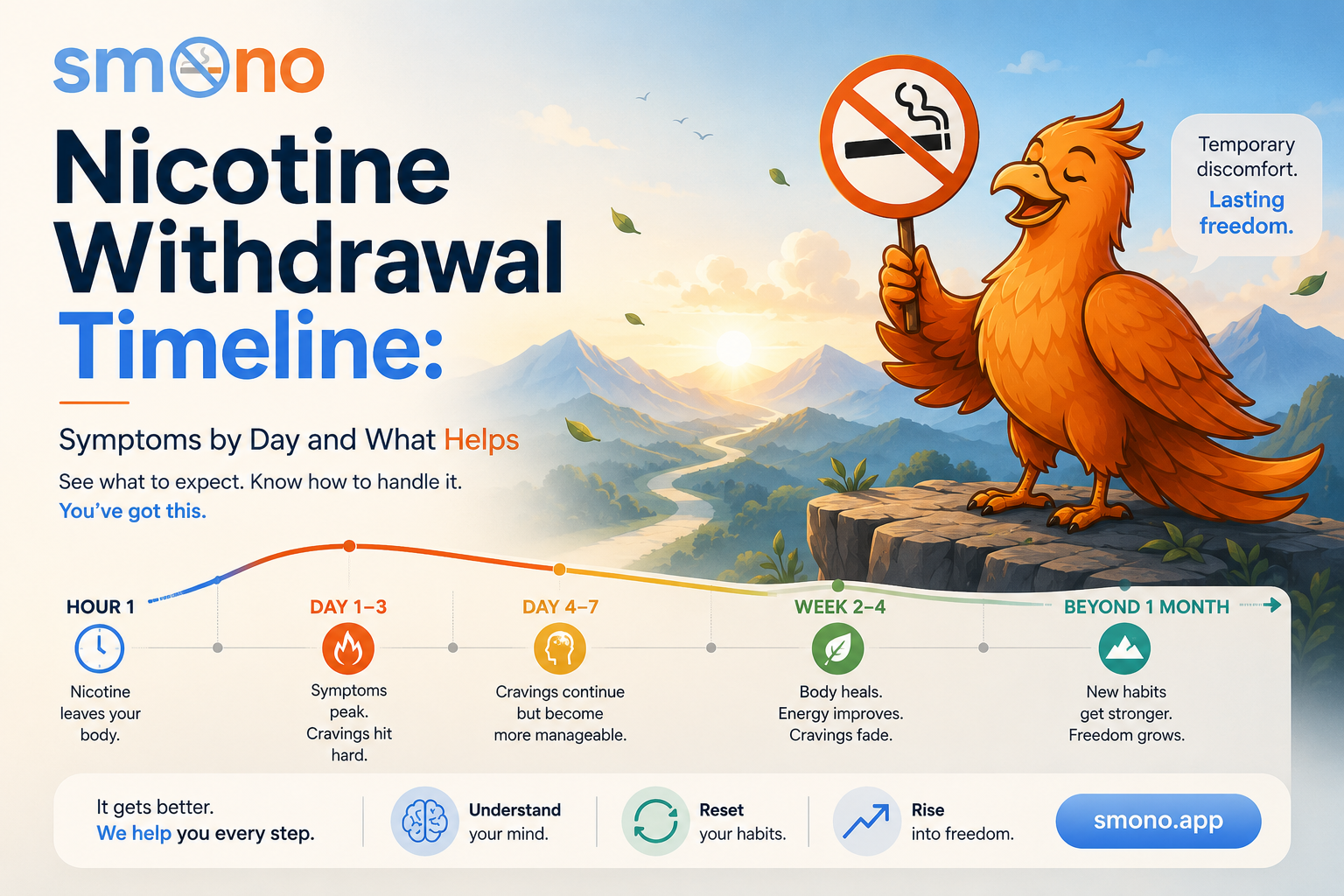
Many regular smokers already feel a mild version of withdrawal between cigarettes without noticing it, because they simply light another one before it builds. Once you stop for good, that early stage becomes more obvious. Within twenty minutes, heart rate and blood pressure typically begin settling toward normal. Within a few hours, the first real craving usually arrives, often felt as restlessness or a strong urge to smoke that seems to come out of nowhere.
This early stage is often more about noticing an absence than feeling unwell. The body is simply registering that something it expected has not shown up.
Days 1 to 3
This is usually the hardest stretch, and it helps enormously to know that in advance. Common symptoms during this window include irritability, restlessness, trouble concentrating, increased appetite, disrupted sleep, headaches, and frequent, strong cravings. Some people also notice a cough, a sore throat, or general fatigue, sometimes referred to informally as smoker's flu, as the airways begin to clear.
Symptom intensity commonly peaks around day two or three. If you can get through this window, the worst of the physical discomfort is usually behind you.
Days 4 to 7
Physical symptoms typically start easing during this stretch, though they rarely disappear all at once. Cravings often remain frequent but tend to feel shorter and slightly less intense than they did in the first days. Sleep gradually improves for many people, and the fog that made concentrating difficult starts to lift.
Mood can still swing during this week, and that is normal. The nervous system is still recalibrating, and a full week without cigarettes is a genuine milestone worth recognizing.
Weeks 2 to 4
For most people, physical withdrawal has largely faded by this point. Energy and concentration continue improving, and the frequent, intense cravings of the first week become far less common. What tends to remain are cravings tied to specific situations, such as a stressful meeting, a drink with friends, or a familiar drive, rather than the body simply demanding nicotine.
This shift matters, because it points to a different kind of challenge than the one you faced in week one.
Physical withdrawal versus learned triggers
It helps to separate two things that often get lumped together as one long, miserable experience.
Physical withdrawal is the body adjusting to the absence of nicotine. It follows a fairly consistent timeline, is strongest in the first days, and fades substantially within a few weeks regardless of what you do.
Learned triggers are different. They are associations built over months or years between smoking and specific moments, such as morning coffee, a stressful phone call, or the walk to your car after work. These associations do not run on a fixed clock. They can resurface long after the physical symptoms are gone, because the connection was never about nicotine levels in the blood. It was about a thought.
This is the part most quit attempts overlook, and it is exactly where Cognitive Behavioral Therapy, or CBT, becomes useful.
CBT responses for common automatic thoughts
Every craving tied to a trigger follows a similar chain: a situation leads to a thought, and that thought produces the urge.
CBT works by identifying that thought and answering it directly, instead of only trying to outlast the craving through willpower. A few examples of automatic thoughts and the kind of response that tends to loosen their grip:
None of this requires forcing the craving away. It simply removes the belief feeding it, which is a large part of what a structured, thirty day CBT program like Smono is built to walk you through, one trigger and one thought at a time.
When to speak with a healthcare professional
This is general information, not medical advice
Most people can manage nicotine withdrawal safely on their own or with basic support, but everyone's situation is different. It is worth speaking with a doctor or another qualified healthcare professional before you quit, or as soon as possible afterward, if any of the following apply to you.
You are pregnant or breastfeeding. You have an existing heart condition, mental health condition, or another chronic illness. You take regular medication, since your dosing needs can change once nicotine is no longer in your system. Your symptoms feel unusually severe, last far longer than a few weeks, or interfere seriously with daily life. Or quitting brings on a level of low mood, anxiety, or distress that feels unmanageable, including any thoughts of harming yourself, in which case please reach out to a healthcare professional or a crisis service in your area right away.
A conversation with a professional does not mean you are doing this wrong. For many people it simply means getting the right support for their specific circumstances, including options such as nicotine replacement products, prescribed medication, or counseling, all of which a doctor can help you weigh properly.
The timeline above holds true for most people, but it is a pattern, not a guarantee, and your own experience may move a little faster or slower. What tends to matter most is not perfect timing but understanding that the hardest days are temporary, that a craving is a wave rather than a rising tide, and that the thought behind it is usually the real thing worth addressing. If you want to go deeper on why resisting cravings through sheer effort so often fails, our piece on why willpower fails when you quit smoking covers that directly.
Common questions
How long does nicotine withdrawal last?
For most people, the strongest physical symptoms peak within the first two to three days and ease significantly within two to four weeks. Cravings tied to specific habits or emotions can continue longer, but they usually become far less frequent once the physical phase has passed.
What are the most common nicotine withdrawal symptoms?
Common symptoms include irritability, restlessness, trouble concentrating, increased appetite, disrupted sleep, headaches, fatigue, and frequent cravings. Some people also notice a cough or sore throat as the airways begin clearing.
Why is nicotine withdrawal sometimes called smoker's flu?
The phrase describes flu like symptoms some people notice in the first days after quitting, such as fatigue, coughing, a sore throat, and general discomfort. It is not an actual flu infection, and it typically reflects the body adjusting as nicotine clears.
How long do cigarette cravings last after quitting?
A single craving usually rises and falls within a few minutes, often around three to five minutes, whether or not you smoke. In the first week these waves can arrive often. Over the following weeks they typically become shorter and far less frequent.
What actually helps during nicotine withdrawal?
Understanding that a craving is temporary and will pass on its own helps many people ride it out without smoking. CBT techniques that target the thought behind a craving, along with simple tools like slow breathing, movement, or a short distraction, are widely used approaches during this period.
Get through withdrawal with a plan built for it
Smono's thirty day CBT program is built around exactly this timeline, with daily support for the thoughts behind every craving.
Begin your reset$24/month · Start free · Built on CBT