
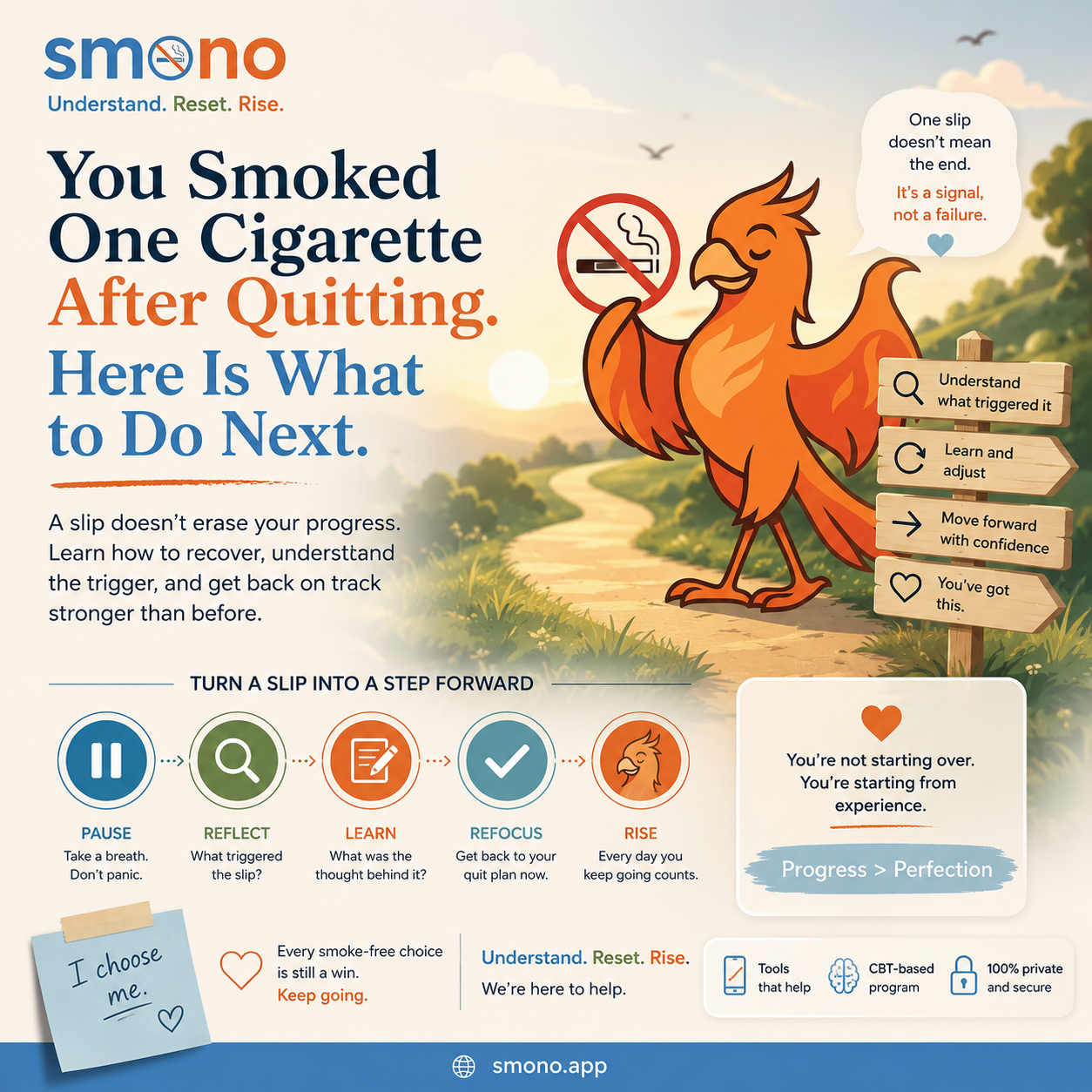
You smoked one cigarette after quitting. Here is what to do next
One cigarette did not erase your progress, and it does not mean you failed.
If you are reading this right after it happened, start with the four steps below. The explanation of why this happens, and how to keep going, is right underneath.
You can come back and read the rest of this whenever you are ready. These four steps are the part that actually matters right now.
If you smoked one cigarette after telling yourself you had quit, the feeling that follows is often heavier than the cigarette itself, a mix of guilt, frustration, and a familiar, sinking sense that you are back where you started. You are very likely not back where you started. What happens in the next day or two matters far more than what already happened, and there is a clear, useful way to think about it.
A slip is not a relapse
Most research on behavior change draws a clear, useful line between these two words, and the difference is not just semantics.
One cigarette, on its own, is a slip. Whether it turns into a relapse depends almost entirely on what happens next, not on the cigarette itself. That is genuinely good news, because it means the outcome is still very much within your control right now, in a way that feels hard to believe in this exact moment but tends to become obvious in a day or two.
Why the counter should not go back to zero
A lot of tracking apps reset your streak the moment a slip is logged, turning thirty four days into zero in an instant. It is worth asking what that number is actually supposed to represent. The physical changes your body went through, the beliefs you worked on, the routines you rebuilt around not smoking, none of that disappeared with one cigarette. A counter that resets to zero measures none of that. It only measures the most recent moment, and treats it as if it erased everything before it.
This matters beyond just how a number looks. Watching weeks of progress collapse to zero over a single cigarette is a strong, specific trigger for exactly the kind of hopeless thinking, I have already ruined it, so what is the point now, that turns a slip into an actual relapse. In that sense, an aggressive reset can genuinely work against the person using it.
Mapping the trigger and the thought behind it
Rather than asking the broad question of why this happened, a more useful question is what specifically happened right before it. Almost every slip follows the same basic sequence.
Naming the situation and the exact thought turns a vague, uncomfortable memory into something specific and useful. Just this once will not matter is a genuinely common thought, and it is worth sitting with honestly, since it is very likely the same thought that will show up again in a similar situation. Recognizing it in advance next time is far easier than recognizing it in the moment for the first time.
A few common thoughts behind a slip
- Just this once will not matter. It usually does not undo progress on its own, but the belief itself is worth noticing, since it tends to repeat.
- I have already ruined it, so it does not matter now. This is the thought that actually turns a slip into a relapse. It deserves the most attention of any thought on this list.
- I deserve this after today. Often shows up after a genuinely hard day, worth naming honestly rather than judging.
- Everyone else is smoking right now. Common in social settings, and worth having a specific plan for in advance.
Recording it as data, not shame
Once the trigger and the thought are named, the most useful next step is simply writing them down somewhere you will actually see again, a note, a journal, a tracking app. The goal is not confession or self criticism. It is building a small, specific record of exactly what your particular risk moments look like, so the next one is easier to see coming.
This single shift, treating a slip as information about your own pattern rather than as a verdict on your willpower, is one of the more reliably useful ideas in behavior change generally, and it applies just as directly here.
Getting back to your plan without starting over
The most practical thing you can do now is continue exactly where you left off, not from the beginning. If you were partway through a structured program, a quit date, a set of tools that were working, pick those back up at your very next moment rather than treating today as a reset point that demands starting the whole process again.
This is deliberately how Smono is built to respond to a slip. Logging one does not restart your program from day one. It maps the trigger, records the thought, and continues your plan forward from exactly where you are, because that reflects what actually happened far more accurately than pretending none of your previous progress counted.
If slips are becoming frequent
One cigarette, handled the way described above, is a normal, survivable part of quitting for a great many people. If slips are happening often, or you notice persistent low mood, strong guilt, or anxiety that feels hard to manage on your own, it is worth speaking with a doctor or another qualified healthcare professional, who can offer support suited to your specific situation.
If you want to understand more about why resisting cravings through willpower alone tends to fail in the first place, which is often what set up the moment that led here, our piece on why willpower fails when you quit smoking goes into that in more depth.
Common questions
Did I relapse if I smoked one cigarette after quitting?
Not necessarily. Most people who study behavior change draw a clear line between a slip, a single, isolated cigarette, and a relapse, a full return to regular smoking. One cigarette is generally treated as a slip. What happens in the days right after it tends to matter far more than the cigarette itself.
What is the difference between a slip and a relapse?
A slip is a single, one off cigarette, often tied to a specific trigger, followed by a return to not smoking. A relapse is a sustained return to regular smoking over days or weeks. The cigarette itself does not decide which one you are in. What you do in the hours and days afterward does.
Should I reset my quit smoking counter after a slip?
Most of what actually changed while you were not smoking, the reduced physical dependence, the beliefs you worked through, the routines you rebuilt, is still true after one cigarette. Resetting a counter to zero can make a single slip feel like every bit of that progress vanished, which is rarely an accurate reflection of what actually happened.
Why did I relapse after quitting smoking?
A slip almost always has a specific trigger behind it, a stressful event, a social situation, a particular emotion, or a moment of low guard such as drinking. Identifying that exact trigger and the thought that came with it is usually more useful than asking why in a general sense, since it turns the slip into information you can actually use.
How do I quit smoking again after a slip?
Pick your very next moment, not tomorrow or next week, as the point you continue from. Identify what triggered the slip, note the thought behind it, and carry on with whatever plan or program you were already using rather than starting the entire process over from the beginning.
A plan that does not reset when you slip
Smono maps the trigger, records the thought, and keeps your thirty day program moving forward from exactly where you are.
Continue your resetFrom $24/month, priced in your local currency · Start free